


Dr. Ashwani Maichand offers a full range of knee replacement surgeries, using advanced minimally invasive and robotic techniques designed to reduce pain, protect healthy tissue, and speed up recovery so patients can return to an active life. The most suitable approach is chosen for each patient’s anatomy and condition. Below are the types of knee replacement he performs:
Robotic Knee Replacement
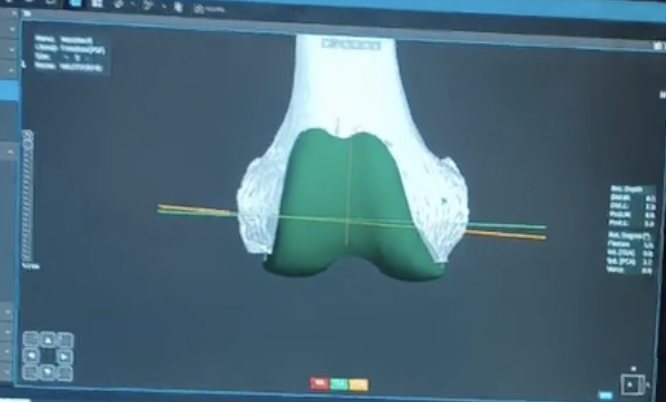
Robotic knee replacement is similar to a traditional knee replacement — damaged tissue is removed and replaced with an artificial joint — but it is performed with the assistance of a robotic arm for far greater precision. High-resolution CT scans build a 3D model of your knee to plan the surgery, and the robotic arm helps the surgeon make sub-millimetre bone cuts on the femur and tibia while trialling implants to achieve optimal ligament balance. Dr. Ashwani Maichand is proud to be India’s first to introduce a fully active robot for minimally invasive knee replacement.
The result is better alignment, balanced ligaments, and less tissue damage, along with minimal risk of infection and durable, long-lasting implants. Smaller incisions mean a shorter recovery, less pain, and a faster return to work, and the improved range of motion allows many patients to comfortably sit cross-legged after they have fully recovered. Because the technique works without jigs, it can be especially valuable for elderly patients.
Read more about Robotic Knee Replacement →
MIS Knee Replacement
Minimally invasive (MIS) knee replacement uses the same artificial implants as traditional surgery but with far less cutting of the tissue around the knee, through shorter incisions measuring 3–6 inches instead of the usual 8–10 inches. Rather than dislocating the joint or flipping the kneecap fully, the surgeon gently shifts the soft tissues and kneecap, saving surgical time and reducing tissue trauma.
The smaller incision means less tissue damage, less scarring, and reduced pain and swelling, so patients often need fewer pain medications and many go home within 1–2 days. There is a lower risk of infection and blood loss, and patients typically show improved knee function and range of motion. Because it is technically more challenging, MIS knee replacement should be performed only by an experienced, expert surgeon.
Read more about MIS Knee Replacement →
Subvastus Knee Replacement
Subvastus knee replacement — also called the quadriceps-sparing or muscle-sparing approach — is a total knee replacement performed by lifting the vastus medialis muscle to reach the joint without cutting the quadriceps tendon. By preserving the natural muscle mechanism, it minimises trauma, reduces long-term weakness or extensor lag, and uses a smaller incision of 3–5 inches compared with the 8–12 inches of traditional surgery.
Patients benefit from improved knee stability, better flexion, and less scarring, with most able to walk with assistance the same day thanks to intact quadriceps muscles. Recovery is typically shorter — around 4–6 weeks for most activities — though the approach is not suited to those with severe deformity, very stiff knees, higher BMI, or prior major knee surgery.
Read more about Subvastus Knee Replacement →
Partial Knee Replacement (Unicondylar)
Partial, or unicondylar (UKA), knee replacement replaces only the damaged compartment of the knee — either the medial or lateral side — rather than the entire joint, using an artificial component of metal and plastic. This more conservative approach preserves healthy ligaments, bone, and tissue, giving a more natural feel after surgery, and is suitable when osteoarthritis is limited to one compartment and non-surgical treatments no longer provide relief.
Smaller incisions mean less blood loss, faster healing, and quicker rehabilitation, with most patients able to go home the same day and resume usual activities after about six weeks. The prosthesis commonly lasts 10 years or longer, and the cost is lower than that of a traditional total knee replacement. It is not suitable for patients with inflammatory arthritis, significant stiffness, ligament damage, or damage across all knee compartments.